My personal journey : A little more on identity profiles and plusgate

This is a watershed moment in online and offline identity and expression that Google has brought to the fore for a lot of people. It’s apparent heavy handed policy on who you express yourself else on their profile pages for Google+ highlights many of the things I have been looking at, talkgin about and experiencing for atleast the past 10 years online.
This was and is the discussion and discovery process that people in “business” and “corporate” life have been bumping into. It cuts across virtual worlds, web 2.0, forums, IRC chat and almost any form of online communication. It also though, when you look at it, amplifies what happens in the physical face to face world.
When you engage in communication with another human being you use lots of cues to judge who it is you are talking to. Generally the main feature is the face. This is the pattern that you brain has remembered as the container for the thoughts and feelings of the person you are communicating with. It is a very strong, very rich and ever changing canvas of emotions and expressions. We think we can usually tell someones mood and intent by their face, and those expressions. In general we can, but it does not stop someone playing us, putting on an act or even entertaining us by pretending to be someone else in a play or movie. When someone is not present and we don’t have that face or that meeting we have word of mouth reputation, or the result of their actions expressed as products, buildings, statues etc.
When we go online we do not have that rich canvas of expressions and motion of a face. Even with a video conference we are translating and losing many of the cues we rely upon. Luckily though we can use more direct self expression, we can leave a trail of actions and intent as digital dna across the very systems we interact upon. We are evolving to understand what actions and what parts of the trail are of use for each of us in determining the viability of another digital representation in being worth interacting with. This applies to business as much as individuals. “They don’t even have a website/twitter account/facebook page/telephone number I am not going to bother shopping with them”
Profile pages, such as the google+ ones that are being policed in a rash way by google are merely a little bit of text and a picture (they do attach to many other things like a dna marker, but for now lets stick with the entry point). They are not your face, they are not you, they are a small veneer and advert to express to people what you do. In the old world that might be called a business card.
The name or names and text description of who are are representing yourself as are not the same as your physical collection of carbon atoms, that are recognisable by your face and may have a parental assigned label on them. You need to get across (should you choose too) why someone might be in the slightest bit interested in connecting with you. Now for people who already know you you given name may be the way they spot you, for others it may be that they have heard of you in some way and need to check you out and for other sets it may just be a serendipitous connection of interest. Each of those is not served by the same pieces of data.
Take the name. I am Ian Hughes I have no middle name, thats on my birth certificate etc. Government issued documents (i.e. validated by some people on the word of some other people). Yet my nickname/handle online of epredator is also how I am known. So we meet at a conference I say my name is Ian, you read my face see I am honest and upstanding but thats it. You meet me online I am Ian/epredator and you see that I have a nickname one that may intrigue, one that you may have even heard of. It may lead you to the conclusion that I have invested some time and effort in certain areas in order that I even have a nickname to share. It provides instant insight.
The same goes for photos.

biobw
predbio
The First picture is of me, its my face, you can tell I am wearing glasses, white male, getting on a bit. Smiling. Without the movement and expression of the face though does that really help you with who I am? Sure if we are going to meet then that may help, but so will the fact I will be wearing my striped leather jacket.
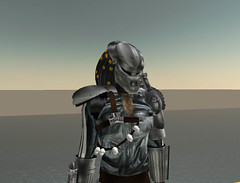
The second picture is of an avatar. A digital expression of me, labelled as epredator, wearing my striped leather jacket. However you can tell from a glance I am a science fiction fan. You may also guess if you are a fan of the culture that the predator character is very strong but full of honour. At no point is there anything where I do not represent who I am. “I wear a mask but don’t hide behind it”.
This just scratches the surface of identity, of me letting you know who I am using the restricted online means we have at our disposal.
This is me as an integrated identity, it is one of thousands of use cases that do not fit the if its you use your name/picture etc.
We are all learning this stuff, I am with me and who I am exploring, the problems and the benefits, I have been for years. “taking a bite out of technology so you don’t have to”. Hence like many I look at google+ and wonder what on earth they are playing at. They are missing some huge opportunities and hitting early adopters and explorers which will backfire on them. Nothing is too big to fail.

***UPDATE email from the google name police 25/1/2011
Hi,

Thank you for contacting us with regard to our review of the name you are
trying to use in your Google Profile. After review of your appeal, we have
determined that the name you want to use violates our Community Standards.
You can review our name guidelines at
http://www.google.com/support/+/bin/answer.py?answer=1228271

If you edit your name to comply with our policies in the future, please
respond to this email so that we can re-review your profile.

Sincerely,

Geoff
The Google Profiles Support Team

So I replied (and complied to get back in and see what the process is)
Hi,
I have edited my name back to Ian Hughes removing the Ian/epredator Hughes.
epredator is in other names I assume that will not give you a problem in the future.

Or am I allowed to be epredator Hughes? I am known mostly as epredator. I was assuming the / was the problem but hearing what is happening to others I assume you would fail that?

Thanks
Ian/epredator

Director of Feeding Edge Ltd
Taking a bite out of technology so you don’t have to.

Metaverse Evangelist
http://www.feedingedge.co.uk
http://www.twitter.com/epredator
http://en.wikipedia.org/wiki/Ian_Hughes_(epredator)
http://www.epredator.com

UPDATE 27/7/2011
I have been allowed back in
Hi Ian,

Thank you for contacting us with regard to the name you want to use with
your Google Profile. After further review, we have determined that your
name is within our Community Standards policy. Thank you for your patience
while we reviewed your profile name. Nicknames should be put in the
“Nicknames” or “Other names” section.

Sincerely,

Geoff

So I am now Ian Hughes on google+ though epredator is more than a nickname. It is part of my actual name. It feels that Google has cut off who I am to other people. I have complied, but will see what they manage to do to address this. It is NOT fixed. I will now get mixed up with a footballer from wales, the high commisioner of Sierra Leone and a journalist and an MD in the car industry. Nice one Google.
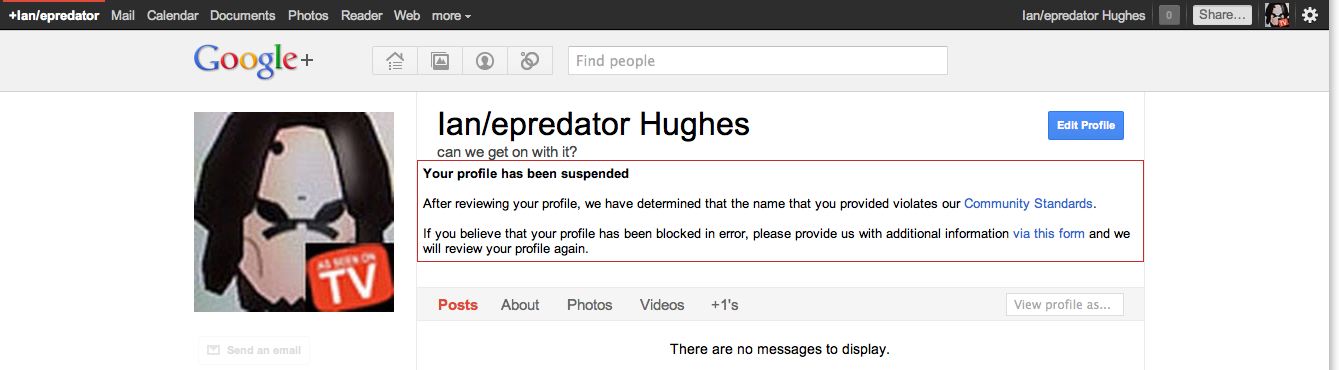

Is that me hiding? I don’t think so! more Google Minus

I feel sorry for anyone with an unusual “given” name, one of the Beckhams, Geldoffs or other rock stars. They just wont be able to hang out on google+ because their “name” doesn’t fit the “pattern”.
So after thinking I was ok as Ian/epredator Hughes on google+ turns out I am not.
I, like William Shatner, got suspended for an apparent name violation or some bad pattern match on their processes. Is it hard to tell this is really me? I mean really? Identity is not binary and is not purely based on a string of ascii characters!

I have filled in the form with just a few URL’s proving that I am known as Ian, Mr Hughes, Mr I Hughes, epredator, epred, oi you, sir, son, daddy, boss etc but we shall see.
Its really a big fat google minus – the muppets

Virtual campus tours for students

I know that if I need to check out somewhere or something new I try and experience it in as many ways as the computer in front of me will allow. We used to just have to sit and paw through prospectuses for places before deciding to visit and check out a place (which is quite a commitment). This 3d virtual campus tours from Designing Digitally and my surnamesake Andrew Hughes (no relation that we have figured out yet) shows the very real benefits of this mirror world application.

This is clearly not there to remove the need to travel and visit somewhere, but to give you the interaction with both a representation of the physical space and the people that are already there to give you tours. So unlike a prospectus you get to talk to people. Why wouldn’t you use something like this?
So here this is an specific industry vertical (in this case education admissions) using game style technology and the benefits of metaverses to engage with people. This is start of it all coming of age.
Well done 🙂
There is a live demo to go and see, just bear in mind if you are form the UK that the our US cousins are more proud of their further education that we are (yes I know they pay but we seem destined on dismantling our system)

Develop 2011 Day 1: less starstruck more enthused

This year was my annual pilgrimage to Brighton for the games dev conference called Develop. I have going to this since I chose my independent career path with Feeding Edge. What I do and what I work on is still at the periphery of the games industry compared to the full on AAA title producer firms, but I do have a huge affinity for the indies.
After last year, sitting hearing something was impossible in one of the sessions, when in fact it is exactly what Second Life and Opensim do I was determined I needed to push a few more game company buttons and so volunteered to talk this year and was accepted. I was part of the Evolve stream which is all about new stuff. In a fast moving innovative industry like the games industry it is surprising that many of the things I have to share are still so leading edge, or if not leading edge then woefully ignored.
The industry itself has a huge part to play in where virtual world and online communication fit into the our lives. They have all the tech and know how to get a double bonus from assets. Games are inherently fun and cool, with very a very creative core at the start, then though they become product. Each game follows the same path as any startup, passionate founders, workers making it real and then the dreaded monetization.
It is also still amazing that all these multi site studios with outsourcing etc are not clamouring to use more efficient or creative ways to communicate with one another, that includes the very things they are building.
Light
I think there was a set unifying sentiments, backed up by some action this year though. Three years ago hardly anyone bothered with “social”, last year everyone botched about it, this year everyone wants to do it properly and better. There is also that realisation that developer community is shrinking, the grand masters are getting older, kids are not getting into programming. It’s not really even being taught. From the newest quirkiest indie dev’s, to higher education to the grand masters of UK game development and even to me with my Cool Stuff Collective show strand we are all doing things to try and let people know that there is more to tech than just using it. You can build with it, you can program, you can share and rather oddly there has never been a better time to be able to get together with others and build. There is though a gap in the technology, which was brought out in David Braben’s Raspberry Pi session. The driver behind this is to try and push towards a small very simple device that you can just plug into a screen and get to code, create build share. In a way that it is not complicated to hit the reset button, just as we did in the old 8 bit days. Lots of kids have access to computers but not to develop on, as they may “break them”.
It really is a great plan and aiming to make a £15 machine with a developer community building the right tools for it and then giving those to entire classes years at schools really opens up the potential for a massive wave of technologically capable builders. In the session the spectre of school ICT came up. How once ICT was brought in computer science dropped out. ICT is about using basic tools on a computer, all skills that are needed, but programming is about problem solving and making things happen. My 8 year old (predlet 1.0) referred to here ICT as “I correct text” which I guess she heard somewhere. It is very different learning to drive a car to knowing how to build one. You need both avenues to be available.
Anyway my highlights of Develop
1. New Stories for New Platforms : A great freeform conversation between Adrian Hon, Alexis Kennedy, David Varela and Charles Cecil moderated by Patrick O’Luanaigh. This was away from the pure tech of games and into the narrative. Dicussions of the stories that form in playing simple board games, storyline narrative versus multiplayer shared experiences. Charles Cecil told some tales of how they remastered broken sword on the mobile years after they had thrown all the assets away.
2. Browser – The place where console, web and social games come together Ilkka Paananen. This was partly an advert for gunshine.net but it was based on experience of pushing to the browser. The mechanics of doing social features better seemed to be a theme too. In Gunshine your friends characters become available to play as your team mates but they play in the style of your friend as AI’s. They also get to level up for the other player (or atleast you can reward them for having been picked). So if you play well, you are more likely to get picked for the team.
3. Gamification – Extending the Game Play into business. Mo Touman gave a pitch on gamification. Which in itself had become a word that was both loved and hated in equal measure. Mo gave examples of lots of platforms toolkits that help with some of the basics of light gamification. Badges, points etc. He challenged the games industry to look at middleware. The tendency was to build from scratch still, which is fine if money is no object. He pointed out things like openfeint, plus+, bunchball(nitro participation engine), scoreloop. Bunchball is the one I need to take a look at having explored the others. In the QA the objections to gamification tended to be they indicated lazy bolting on of points. In fact this is a much deeper subject but I guess the early examples are just that.
4.Social Games, Music and Fashion : New frontiers. Paulina Bozek from INENSU gave a great pitch on their social clothed reuse/swapping project and also the up and coming superfan for the music industry. What I liked was the references to the madness of the record industry in trying to control and stifle creativity in the name of profit. Which in the long run fails. The example was of a Bieber fan video, lots of fans had put a montage of photos of themselves each with a word from the song written on a hand, a mirror, a placard etc and posted it to youtube. Bieber commented on how cool it was and that he liked it, then his record company proceeded to issue DMCA takedowns all over the place for breach of copyright. Hitting at the hardcore fans who want to share and create out of passion and interest is, lets face it, dumb.
5. What’s Next. A great panel which included Alice “@wonderlandblog @makielab” Taylor. It was lots of riffing on some ideas, Onlive and Xbox were both represented too. One discussion was have the consoles got good enough that we don’t need to bother pushing forward with the visuals any more. Will there be a next next gen etc. generally we all wanted to not have to bother with worrying what something was on, but be able to play anything anyway.
6. Keynote: Lessons from building Moshi Monsters to 50m Users. Michael Acton Smith was his usually chirpy and enthusing self. Telling tales of the dark days of nearly closing, of burning capital, changing course and then the explosion that is Moshi and moving into other non digital areas. To see the empire grow from those early ideas (which I remember seeing on a visit to mind candy way back) to what it already is and to see where it is heading really is like watching a new Walt Disney arise from the web. (Well done to Moshi Monsters for picking up their award at the ceremony the next day too)
More to come….

This camera is amazing – no need to focus!

I saw a few tweets yesterday and I retweeted @JimMacMillan about a camera that does not need to focus. It is called Lytro, shoot now focus later It uses a technology called lightfield. I have only an inkling of how it works, but I need to read up on it now!. There are some simple explanations over at the Lytro site and for the more scientifically minded the CEO’s dissertation is there too

However it works though it is fascinating. A few of us back at the old firm I worked for had tried to work out how to take a photo using a regular digital camera but provide extra layer information so that the photo was in fact made of photoshop layers. It was not a great success, but we did try a few tricks to separate foreground and background. This however really does that with every point or beam of light in a scene. The ability to explore a photo zoom in on things that were not maybe the original intention of the photo is very Blade Runner.
I am guessing this has some significant implications for the 3d capture of scenes both from a photographic point of view but also that data will have some way to be processed in the future to create our 3d models. Combine Lytro style image capture with Kinect depth sensing, without the need for the multiple points of infrared light the kinect has to fire out. It would seem we have a leap in precision?
I am looking forward to finding out more and in the meantime check out their example photos and play spot the predator in one of them.

Identity is not binary – plusgate

I have to join in with support for those people out there who wish to use a pseudonym or handle to express themselves on the internet. This is all sparked out of the apparent short sightedness of Google and it Google+ on suggesting that if you don’t use your “real” name you can’t be on the “service”.
It is true that this is a free service, it is one, like most social networks that the owners can choose their own terms of service, however it is not an excuse to miss the point of all this connectivity.
The web is about people, social media is about people, virtual worlds are about people. People are not merely defined by a first name and second name and a physical home address. Those are merely an anchor point for physical services. People are defined by their actions, by their affiliations. They are also defined by the creative output. Social networks are not a forensic legal network of our DNA kept and logged with fingerprints, voiceprints and an absolute 100% certainty “we are who we say we are”. I am sure some people think that would be the ideal, however it is missing an important point.
Just because you know someones real name and potentially real address it does not mean that you know that real person. It no more indicates that they will tell you the truth or tell you a lie than if you ask them to roll a dice for you, 3 means truth 5 means lie the others are not sure.
People choosing to either use a different handle, a nickname or an AKA are not usually hiding. A few characters or a picture to express who they are in the context of a particular social network is more likely to offer insight into who they are rather than the surname handed down by birth and a first name given by parents.
Trust is very different from physical appearance or labelled identity. Having a human face profile picture does not make that profile “genuine”. The actions of someone or the organisation behind the profile are where trust is formed and where bonds are strengthened.
I can understand worries about accountability or security of knowing the same person is using the same account, but these are completely different from anonymity or pseudo anonymity. I am more than happy to talk and deal with the same person time and time again regardless of their “name” just as I am happy to deal with them regardless of race or creed. If the “name” they have made for themselves and their actions is an alias then so what?
Much of this has sparked form the virtual world communities, in particular Second Life choosing to help and early adopt Google+. In part to get away from the over controlling nature of Facebook and it’s names and identity policy. It seems though Google want to be a copy of that.
I am wondering where this ends though. Should we not be able to search the internet for fictional characters, are we not able to engage with people with imaginations online. Should everything be geared to a replication of the physical world?
It is lazy to treat identity as binary. I have seen corporations and companies try this with employees (and fail). We are complex messy collections of carbon atoms. We all have more than one mood and persona. Different situations require us to suspend disbelief or augment ideas. Nothing is black and white.
Does this affect me? Well not exactly. I am known as epredator on a number of systems. People call me epred when we meet. I am also Ian, Mr Hughes, Sir, Oi You, Dad, Son. I have an avatar in Second Life that wears a mask, yet I don’t hide behind that mask. I have not made a specific separation between me online and me offline in that I am shades of me and shades of characters in different situations at different times. I do however admire those who have a completely separate online nom de plume, why shouldn’t they? It is part of the magic of the human condition. Just as with a magic trick, once you know how its done it loses its appeal.
So, who ever you are, do not stifle creativity and creation, do not stifle humanity by fixing a technology based policy in place just because you think it “might be a good idea if…”. I reserve the right to have an anonymous profile that I can fill with whatever I want to explore a character and some ideas. Google “do no evil?” killing creative expression sounds rather evil to me?

Metameets – The last post : 4 of 4 (plus 1)

Finally I get to talk about the last parts of the Metameets conference gathering last month. It is rare that posts take this long as I prefer to fire a quick post up and not leave things lingering, however it was so packed that that just was not going to happen to do it justice.
Meeroo
First it was great to see Toxic Menges tell us all about the now famous Meroos. These virtual life critters are a Second Life phenomenon. They are not simple scripted in world creatures. Their evolution and life cycle is controlled on servers outside of Second Life. They are registered purchased goods expressed and interacted with in Second Life. I did buy a Meroo after the presentation, but it has run away as I forgot to feed it. A-Life is always fascinating and when combined with a virtual world and a value economy even more so. Meero’s evolution and breeding cycle, specializations and changes are all out there to be discovered and lots of people are farming them for profit, or caring for them as pets.
This is really advanced a-life in how it works within the scope of a shared environment. Toxic pointed out how the Meeroo’s come up and give your avatar a hug in world. This is not a standalone tamagotchi.

Next up was a remote pitch by film maker Bernhard Drax/Draxtor Despres on The making of SL/WoW documentary Login2Life. This was part in world (we all rezzed with him in virtual Amsterdam) and then heard all about this new reportage covering all elements of the SL and WoW experience. It is running on German TV very soon and hopefully will be available world wide as we all know Draxtor does great work.

We have Melanie Thielker back to do a second presentation specifically on Roleplay in Virtual Worlds. Melanie enthused about the potential of role play in virtual worlds, how characters form and play and act. It is a very specific form of entertainment that can be a little scary for people used to being handed their experiences. In some ways it is like the difference between a radio and choosing your own songs. Both work, both co-exist and virtual worlds provide an ideal way to explore what role play is.

Toni Alatalo got a chance to show off RealXtend and the subtle differences and extensions that this platform has over SL and Opensim. One of the key elements of the model this works on is that everything is a world object. There is no specific need to have an avatar or an island. (So much nodding and whooping from me). Toni also gave his presentation with the virtual world, mixing and zooming around screens and examples of eagles swooping and catching fish.

Timo Mank came to talk TMSPTV a meditative space and a playground for co-creation across realities. This was an intriguing project that turns the island idea on its head. This was a creative collective that represents its stories and ideas in Second Life in order to reach a wider audience yet is drawn from a physical location which is itself a communal physical island. It has a culture of storytelling and each day the stories are retold as part of a daily routine. That culture is capture and placed in world.

Karen Wheatley talked about The Evolution of Virtual Theatre. This was a fascinating insight from a theatrical production point of view. Karen stages live plays in Second Life but adapted for Gorean culture. The Jewell Theatre has been staging full-length original plays in Second Life since August 2007, so there is a lot of experience on hand. In staging plays Karen has to consider the fact that the audience actually may be sat in one place but can move the camera anywhere. There are no cheap seats in SL. Set changes can happen very much quicker too, with objects rezzed and moved as needed. Most of the plays have been text based due to unreliability of voice sometimes. Chat was adjusted with the equivalent of a text microphone that relays the chat labelled as the character name not the avatar name. Yes thats right a person with an avatar playing a character lots of levels of redirection there. Actors also have to be aware that they need to explicitly puppet their avatars with a directors missive “T*ts to the action people”. Having had to deal with the challenges of locations and tv studios I appreciated the challenges of staging in SL in this more directed way. As Karen said you use what you have got and the challenges of a platform or place become part of the production.

Steve Zapytowski continued the theatrical strand with Blended Performance: Live Actors and a Virtual Player. Steve is professor of Design and Technology, Kent State University. Founding member of the Institute for Learning in Virtual Environments (iLIVE). He presented from in SL and we watched some local videos of his work. This was about a physical production of Hamlet but the ghost was a stage effect that was pre-render animation of a human figure. They had to mix the pre-renders with suitable lighting and cueing to make the ghost move, appear, puff away etc. It look very powerful and very interesting. There was lots of discussion about live puppetry versus the pre-canning but again thats a choice of the environment and how to work. Each has its flavour and challenges.

Finally up was Chantal Harvey / Mamachinima that strangely I already blogged, it was where I started this thread of metameets.

http://www.feedingedge.co.uk/blog/2011/06/21/metameets-2011-part-1-of-n/
http://www.feedingedge.co.uk/blog/2011/06/23/metameets-lazy-teachers-and-revolving-doors-part-2-of-n/
http://www.feedingedge.co.uk/blog/2011/06/28/metameets-part-3-of-n-grid-wars-and-envelope-pushing/

So that was Metameets. An amazing collection of ideas, people and passion. I throughly enjoyed both being the MC and hearing everything and meeting everyone. The Club Karlsson venue was very cool too and everyone was very helpful . What a blast ! Well done all. In particular joja dhara for bringing us all together in the first place (though she asked me not to thank her at the time so I have messed that one up 🙂 )

All the pieces are falling in place – Unity3d

Back in late 2009 I wrote a post saying we had all the pieces to start seriously building virtual world toolkits and environments from off the shelf pieces.
Today I have seen two releases arrive of new hosted toolkits and services, both using Unity3d and some of the other pieces related to hosting a server component. They are both from stalwarts of the virtual worlds industry and both with former close ties to Linden Lab and Second Life.

In not particular order the first is from SecondPlaces.net called Unifier. As with all Unity environment this benefits from the browser plugin to let it run on most browsers. According to the site its using smartfoxserver to broker the positions of the other avatars and flash voice for VOIP.
The key is that it acts both as a hosted service on Amazon EC2 (i.e. thats where the server will be running for your instance) or as a run yourself service. Smartfoxserver is a relatively simple java application to get going on a server with some config for ports etc needed. The important parts are it knowing what it needs to keep a track of an what clients subscribe too. There also appear to be lots of interaction with other content, whiteboards etc and the sort of dynamic tools needed to interact online. So a lot of work has gone into productising this.
The second offering is from Tipodean which is both a service to run peer to peer unity3d (which looks like it uses the unity3d master server) and an OpenSim to unity3d conversion service. So you can pay to get your build moved from prims to the mesh of unity3d and then have some unity3d polish applied to it.
It is not clear how dynamic any of the environments are, as typically, whilst unity3d can load new assests on the fly it is more complicated to set that up than the ability for people to walk around a fixed environment.
The upshot of all this is that there is more choice and scope for the market to grow. These join the other services out there and form part of an SL counter culture, in a slightly different way to the counter culture of Opensim.
It’s all good.

Get the next generation educated – making games

Today a report was published by NESTA written by Ian Livingstone OBE and Alex Hope into the educational and institutional shortcoming and development needs to ensure that ‘the UK can be transformed into the world’s leading talent hub for video games and visual effects.’ I realise the Uk angle is rather parochial but it is important to all countries and organisational units to pay attention to this.
Nesta Next Gen
(picture from NESTA with Little Big Planet Copyright Sony Computer Entertainment
The full report is here.
The report attracted my attention with my BCS animation and games development group hat on. The BCS as an IT professions organization seeks to offer an umbrella for the growth of skills and the nurturing of talent and interest in the technology sector. (Formerly called the British Computer Society). The BCSAGD group is trying to help promote awareness of the depth of skills and talent in the games industry as much as it is trying to help the games industry map to what goes on in the apprently more serious IT industries.
Having worked across all these industries, and now also encorouaging kids into tecnology via The Cool Stuff Collective TV show I know that whilst games have some specific challenges the core of the industry has the same profile as an computing based industry. The challenges of design, code, test and run and having to deal with constant disruptive innovation applies to all industries. It benefits, though, from being things that people can see and create. You don’t teach music by showing the inside of a piano, but its great to know how it works to get the best out of it.
I think the reach of the BCS into traditional games industries is pretty low, yet when you read this reports findings you cant help but notice we are all heading for the same noble goals.

The following is an extract of the key reccomendations from the above report.

Schools
Bring computer science into the National Curriculum as an essential discipline.
Sign up the best teachers to teach computer science through Initial Teacher Training bursaries and ‘Golden Hellos’.
Use video games and visual effects at school to draw greater numbers of young people into STEM and computer science.
Set up a one-stop online repository and community site for teachers for video games and visual effects educational resources.
Include art and computer science in the English Baccalaureate. Encourage art-tech crossover and work-based learning through school clubs.
Build a network of STEMNET and Teach First video games and visual effects Ambassadors.
Introduce a new National Video Games Development and Animation Schools Competition.
Design and implement a Next Generation of Video Games and Visual Effects Talent Careers Strategy.
Provide online careers-related resources for teachers, careers advisers and young people.

Universities, Colleges and Vocational education
Develop kitemarking schemes, building on Skillset accreditation, which allow the best specialist HE courses to differentiate themselves from less industry-relevant courses.
HEFCE should include industry-accredited specialist courses in their list of ‘Strategically Important and Vulnerable’ subjects that merit targeted funding. Industry commits to these courses through industrial scholarships and support for CPD for lecturers.
Raise awareness of the video games and visual effects industries in the eyes of STEM and arts graduates.
Give prospective university applicants access to meaningful information about employment prospects for different courses.
Develop a template for introducing workplace simulation into industry-accredited video games and visual effects courses, based on Abertay University’s Dare to be Digital competition.
Leading universities and FE colleges sponsor a high-tech creative industries University Technical College (UTC), with clear progression routes into HE.
Kitemark FE courses that offer students the best foundation in skills and knowledge to progress into Higher Education.

Training and continuous professional development
Skillset Creative Media Academies and e-skills UK’s National Skills Academy for IT to work with industry to develop specialist CPD training for video games and visual effects industries.
Support better research-oriented university-industry collaborations in video games and visual effects.
Continue to treat the 18 visual effects occupations on the Government’s shortages list as shortage occupations.

So take a look at the report and see if there is anything, either as a BCS member, as a teacher, as a volunteer, as a parent or as a leading employer that you can do to push these goals.

Having seen the enthusiasm of my kids (the predlets) for creating with technology at a young age we really should level up the sort of education opportunities we give young people from the earliest of ages. Scary for the teachers I am sure but there are lots of us out here to help.

Some interesting pro-made gaming webisodes

Yikes I used webisodes (how very turn of the century). However it looks like a good series is forming on games and gaming, in 4 minute bite sized chunks with Dom Joly. He always it entertaining, just as Charlie Brooker is but for different levels of sarcasm.

This series is by Channel Flip who I previously noticed had done Richard Hammond (of Top Gear fame) Tech Head. I guess having done some technology presenting on TV I was not overly impressed with Tech Head. Probably just professional jealousy, but it did not seem Hammond’s heart was in it, unlike Top Gear.
Anwyway Dom Joly is looking good in this and its good to see the subject covered with his style in place.
See what you think.